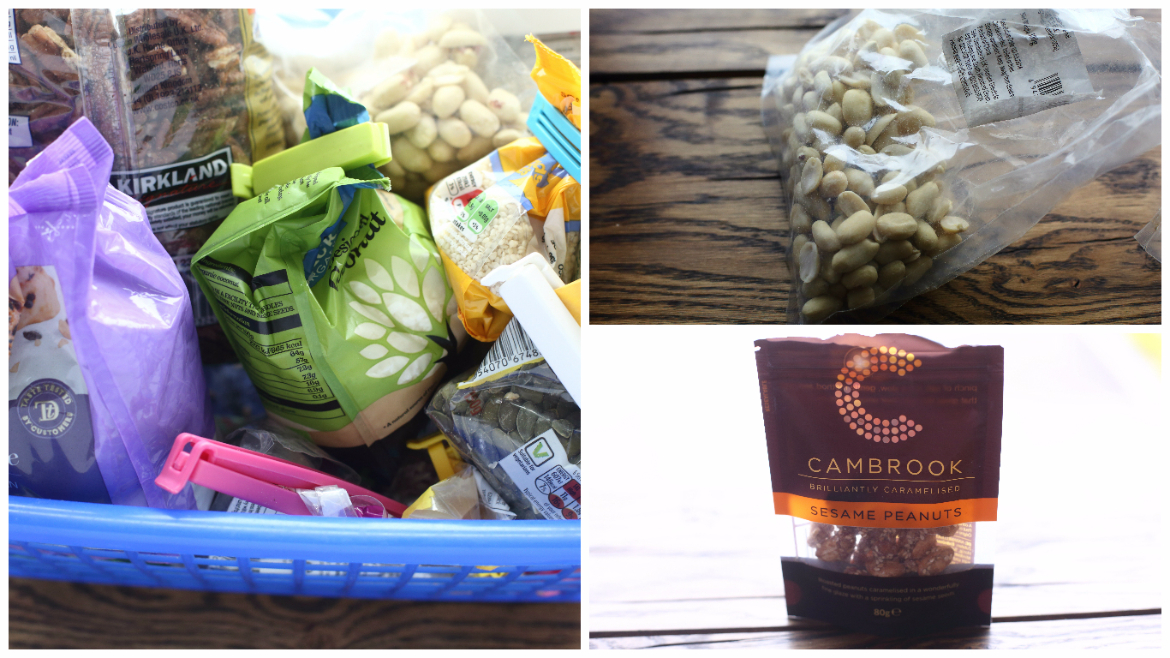
I don’t know if you’re like me, but I have a basket of packages of half used seeds, nuts, dried fruit and grains in my cupboard, some of which have been there for so long it’s slightly embarrassing! It is very good though if you are making your own granola as you can throw in pretty much anything and it still tastes great.
The other day my husband came home from the supermarket with these Caramelised Sesame Peanuts which were so moreish it made me upset because the package was way too tiny, a measly 80g! I looked at the ingredients and thought ‘I can make these’. In fact, I could make them that very moment thanks to my lovely basket of miscellaneous packages and that’s what I did. I had some raw unsalted peanuts which I bought ages ago to use as a topping for homemade Pad Thai, which were begging to be used. The result was really similar, I would say that the store bought version is slightly sweeter, but I prefer to err on the side of making things healthier if I can so I am happy with the result. Also, the store bought version had honey on the ingredients list, but I swapped this for a mix of maple syrup and coconut sugar.
Feel free to experiment with whatever nuts and seeds you have lurking in your cupboards and I hope you enjoy!
Written by Corin
Makes: 300g
Prep time: 2 minutes
Cooking time:20 minutes
Ingredients
300g unsalted raw/plain peanuts
1-2 tablespoons sesame seeds
2 tablespoons maple syrup (substitute honey)
65g coconut sugar (substitute white or brown sugar)
Half a teaspoon of crushed or fine sea salt (I used vanilla flavoured sea salt)
Place the peanuts in a bowl, add in all other ingredients and mix well.
Line baking tray with silicone mat or grease proof paper and pour nuts onto tray. Spread the nuts out as much as you can.
Bake in oven for 10 minutes, stirring at this point, then for a further 10 minutes keeping an eye on them to make sure they don’t burn. Remove from oven, let cool slightly if you can and enjoy!
With all the sunshine lately, this gorgeous sorbet beckons. It is light, fruity and would be fabulous served between courses, sometimes called an Intermezzo to cleanse the palate, or as a refreshing dessert.
Tangy yet sweet, the tangerines add a wonderful colour and flavour to this dessert.
Written by Corin
Serves: 10-15
Prep time: 20 minutes
Cooking time: 15 minutes (plus 2-4 hours to cool in fridge, churning time in an ice cream maker, then 8 hours in freezer)
Ingredients
Roughly 500ml dry Prosecco, chilled
Zest of 5 tangerines (approx 1-2 tablespoons)
1 litre of tangerine juice, strained (15-20 tangerines depending on their size)
Ice cream maker (don’t forget to put the bowl in the freezer well in advance, following the manufacturers instructions before use)
Spoon
Spatula
Sieve
Hand grater or zester
Juicer
Cooking Method
Put the bottle of Prosecco in the fridge to chill.
Place the water in a small saucepan and add the sugar. Use a spoon to stir the mixture over a medium heat until it is combined. Once combined, increase the heat slightly and bring the mixture to a gentle boil, then remove from the heat. Transfer the mixture to another bowl and put in the fridge to chill. (about 2-4 hours)
Meanwhile wash 4-5 tangerines and dry them, then use these for the zest/finely grated peel.
Juice enough tangerines until you have approximately 1 litre of juice. Pour the juice through a sieve to remove the pulp. Then place in a covered container in the fridge to chill.
Place the container you intend to keep the sorbet in into the freezer to chill. Once all mixtures are really cold, mix together the tangerine juice, zest, sugar mixture and Prosecco using a whisk, then transfer it to your chilled ice cream maker bowl and freeze/churn according to the manufacturer’s instructions.
Transfer the sorbet into your chilled container and place in the freezer over night or until hard before serving.
Ice cream is one of my favourite things. Whether it be regular ice cream, frozen yogurt or my newest love, coconut milk ice cream. I splurged last May and bought myself an ice cream maker and I haven’t regretted it. I have made many frozen yogurts, custard ice cream recipes, and so many varieties of coconut milk ice cream. I’ve come to like the coconut milk ice cream more than traditional ice cream because it is lighter and more refreshing to eat while still having the perfect creamy consistency as well as just the right amount of sweetness.
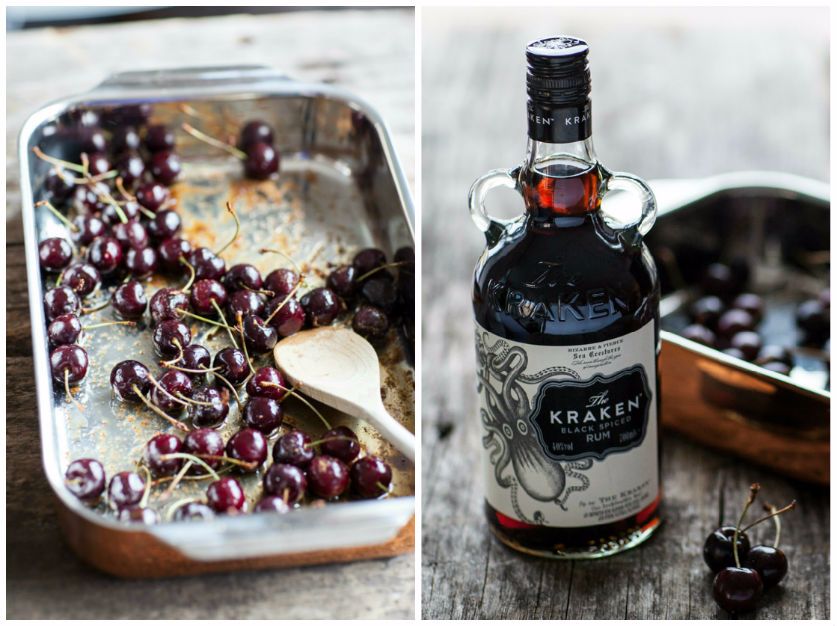
I’ve roasted the cherries with coconut sugar and 30ml of ‘The Kraken’ spiced rum, which adds a delicious flavour, however if you are going to be serving this ice cream to children or someone avoiding alcohol, it’s best to omit it altogether from the recipe. In general, about a tablespoon of alcohol added to coconut ice cream helps prevent the ice cream from freezing too hard. Since there is over 3 tablespoons of rum in this recipe, it takes much longer to solidify in the freezer; however, this makes it much easier to scoop when you’re ready to eat it.
The arrowroot powder in coconut ice cream is essential to create a creamy texture. This can be substituted with corn starch, however arrowroot powder can be found in the baking isle of most larger supermarkets. I use either honey or maple syrup to sweeten the ice cream, but if you want to make it vegan make sure to use maple syrup.
The chocolate chips I used are from and made by local Sheffield independent Chocolate shop and Cafe Cocoa Wonderland. I used their ‘Cute as a Button’ dark chocolate buttons in this recipe, but can also highly recommend the lemon/lime ones if you’re in the mood for a treat. You can order some of their chocolates online, so go on and indulge!
Written by Corin
Serves: 8
Prep time: 10 minutes
Cooking time: 5-10 minutes (plus 2-4 hours to cool in fridge, then 3-4 hours in freezer)
Baking time:20 minutes
Ingredients
2 cans full fat coconut milk
120ml runny honey (substitute maple syrup to make it vegan)
1 teaspoon vanilla extract
80ml The Kraken Spiced Black Rum (optional)
2 tablespoons arrowroot powder/starch
Pinch of fine grain sea salt
1 tablespoon coconut sugar (can substitute with brown sugar)
350g cherries
100g dark chocolate, chopped (I used chocolate chips which I chopped slightly before adding)
Ice cream maker (don’t forget to put the bowl in the freezer, following the manufacturers instructions before use)
Spoon
Spatula
Cherry pitter (optional)
Cooking Method
Add the coconut milk, honey, vanilla, and salt to a saucepan and bring to a gentle simmer over a medium heat while whisking frequently.
While the coconut milk mixture is heating remove a ladle of the warm mixture into a separate bowl and mix in the arrowroot powder. Use a whisk to mix thoroughly so no lumps remain.
Once the coconut mixture is simmering, add the arrowroot mixture in the small bowl and mix constantly for 1 minute.
Remove from heat and add 50ml of rum. Let the mixture cool slightly, stirring every so often during the process, then transfer to the fridge until very cold (approx 2-4 hours).
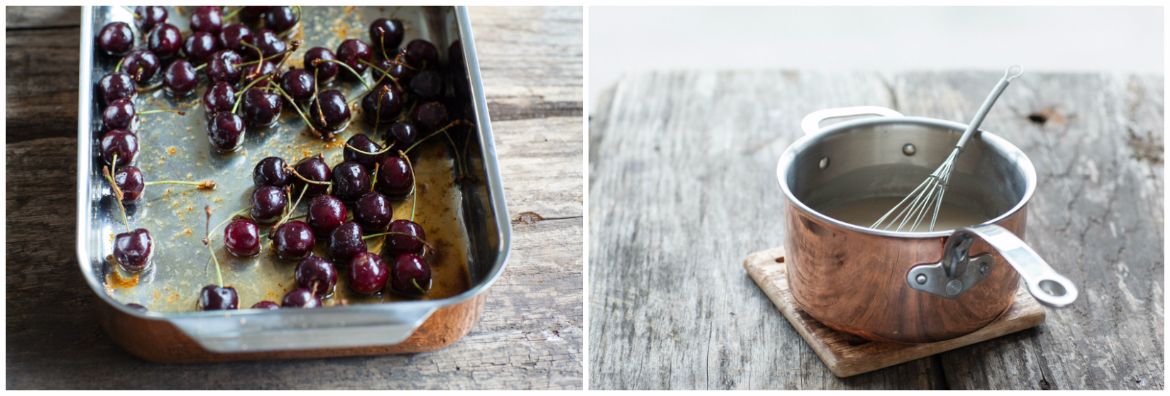
Meanwhile, preheat oven to 200°C. Wash the cherries and strain them so they are fairly dry. Place them in an oven proof dish and pour over 30ml of rum and sprinkle 1 tablespoon of coconut sugar on top. Shake the tray slightly to evenly distribute the rum and sugar.
Place in the oven for 20 minutes shaking the tray about half way through baking time. Keep an eye on them so that they don’t burn. When they start to shrivel slightly remove them from the oven and let them cool before removing the stems and pips. I did this by hand but you could use a cherry pitter if you have one. Then chop the cherries into quarters using a knife and fork.
Before you churn your ice cream put the container you intend to store the ice cream in into the freezer to chill.
Once the mixture is very cold, whisk it briefly then transfer it to your chilled ice cream maker bowl and freeze/churn according to the manufacturer’s instructions. Add the roasted cherries and dark chocolate in the last 5 minutes of freezing until thoroughly combined.
Transfer the ice cream into your chilled container and place in the freezer for a couple of hours before serving.
It’s been a long time coming this year but finally the Easter weekend is within reach.
To start us off this week Hannah waltzed in first thing Monday morning with a spectacular Easter cake.
What a great way to start the week and to continue in the Easter spirit, we’ve decided to have a crack at Ren Behan’s Creme Egg Cheese Cake recipe which you can find here. We addeda slight twist, using the different mini pans to create ‘individual’ portions as well as varying the Easter toppings too.
We used Malteaster Mini Bunnies in the mini casserole, Cadbury’s Creme eggs in the mini frying pan, Cadbury’s Mini Eggs in the mini pan and Milkybar Mini Eggs in another mini pan. For the Mini Eggs cheesecake Fiona suggested crushing some Mini Eggs and adding them to the cream cheese mix, which turned out great. If you’re looking for playful dessert ideas this Easter, I would definitely recommend this one. It’s super easy because there is no baking and you could definitely get the kids involved, from crushing the biscuits for the base to adding the decorations! Happy Easter!
Comments Off on Red Currant and Elderflower Ice Cream
Summer has certainly hit us this month and who can complain? With the lovely heat everything has come into full force, flowers blooming left, right and centre and not to mention the summer fruits. We have been up to our ears with red currants this year and have been investigating what to do with them. We’ve found a lot of recipes that call for red currant jelly, but not as many calling for fresh red currants.
With a desire to make something other than red currant jelly we decided to try something a little bit different and definitely weather appropriate, red currant and elderflower ice cream. The tartness of fresh redcurrants is really nice alongside this rich ice cream so make sure you reserve some to garnish when serving. We picked a full punnet and stewed them with 50g of caster sugar and 2 tablespoons of water per 450g of fruit.
Any remaining stewed fruit is wonderful used as a topping for yoghurt, or added to dressings for salads, marinades for meat or even as a fruit syrup for a cocktail (see below for a below recipe for Red Currant Cosmo).
If you’re looking for a few more recipes using fresh red currants we recommend checking these ones out:
Thoroughly wash the red currants and remove their stems before placing in a small saucepan with the 50g of sugar and 2 tablespoons of water.
Bring to a gentle simmer over a low to medium heat stirring often taking care the fruit does not burn. Once the currants are softened use the spoon to break them down further against the sides of the saucepan.
Remove from heat and allow to cool slightly. Pour the fruit into a metal or nylon sieve which is placed over a bowl just a little bit larger than the sieve. Use a spoon to push the fruit around in the sieve to help get all the liquid through until what remains in the sieve is fairly dry. Discard the pulp and seeds.
Mix in 2-3 tablespoons of the elderflower cordial into the juice from the currants and set to one side.
For the ice cream
In the smaller saucepan combine the egg yolks, 60g sugar and 100ml water. Over a low heat cook gently, stirring constantly until thickened. Remove from heat and let stand for 5 minutes.
Meanwhile, pour the double cream into a large bowl and whisk until it forms soft peaks, add the vanilla extract and whisk it in gently.
Fold the cooled egg mixture into the double cream. Add around 230-250ml (1 cup) of the red currant and elderflower juice and mix thoroughly. Keep any left over juice in a small container in the fridge to drizzle over top the ice cream when serving.
Place the mixture in a Tupperware container or loaf tin and put in the freezer.
Every half hour, for the first few hours remove the ice cream from the freezer and gently stir to avoid ice crystals forming in the freezing process. Make sure to scrape the sides to loosen the more frozen parts.
Leave the ice cream in the freezer until suitably frozen.
Serve with garnishing of fresh red currants and red currant and elderflower juice.
Put the butter and water into the 16cm saucepan. Heat slowly to melt the butter then turn up the heat and bring to a rolling boil.
When the mixture is boiling really fast, tip in all the flour with the salt and remove the pan from the heat.
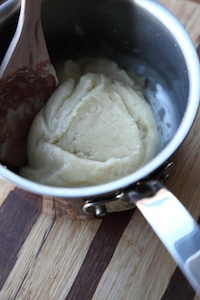
Working as fast as you can beat the mixture hard with the wooden spoon: it will soon become thick and smooth and leave the sides of the pan.
Spread the paste on a plate to cool to room temperature.
When the mixture is no longer hot, return to the pan and beat in the eggs, a little at a time, until it is soft, shiny and smooth. If the eggs are large, it may not be necessary to add all of them. The mixture should be of a dropping consistency – not too runny. (dropping consistency means that the mixture will fall off the spoon rather reluctantly and all in a blob; if it runs off, it is too wet, and if it will not fall even when the spoon is jerked slightly, it is too thick.)
Put teaspoons of the choux mixture on a baking sheet, about 8cm/3in apart.
Bake in a preheated oven for 20-30 minutes. The profiteroles will puff up and become fairly brown. If they are taken out when only slightly brown, they will be soggy when cool.
Using a skewer, make a hole the size of a pea in the base of each profiterole and return to the oven for 5 minutes to allow the insides to dry out. Leave to cook completely on a wire rack.
When cold, put the sweetened cream into a piping bag fitted with a small plain nozzle. Pipe the cream into the profiteroles through the holes made by the skewer, until well filled.
Put the chocolate, butter and water in a heatproof bowl set over, not in, a saucepan of simmering water and leave until melted.
Dip the tops of the profiteroles in the melted chocolate, then allow to cool.
NOTE: If no piping bag is available for filling the profiteroles, they can be split, allowed to dry out, and filled with cream or crème patissière when cold, and the icing can be spooned over the top. However, made this way they are messier to eat.
Pancakes are quick, easy and always delicious. Luke French‘s recipe for American style pancakes is fuss free way to kick-start your morning. There is a video below of Chef Luke demonstrating how to make these pancakes. He also tops them with a lovely combination of smoked salmon and samphire, which would make a lovely evening mean and shows that pancakes don’t have to just be for breakfast!
Add the egg to a mixing bowl and whisk in the butter until slightly fluffy.
Add the sugar and whisk until smooth.
Sift together the flour and baking powder into a separate bowl.
Gradually add the flour mixture to the egg mixture. Whisk until smooth.
Add the milk gradually, scraping the sides of the bowl when necessary. Mix until it is a thick smooth texture and use straight away.
Cooking Method
Add a couple of knobs of butter to the pan and melt over a medium heat. This will create a nice even coating to the pan. Heat the butter until it froths.
Add half a ladle of the batter to the pan.
Wait until the top of the pancake begins to bubble, turn it over using a turner or pallet knife and cook until both sides are golden brown. The pancake will rise to about 1cm in thickness.
Remove the pancake from the pan and keep warm in an oven heated to 90C on a plate or a tray.
Once all pancakes are cooked, serve with a topping of your choice.
Comments Off on Rhubarb Crumble with Oats & Malted Milk Custard by Ren Behan
We’ve worked with Ren Behan for a number of years now. She is a renowned food writer and author of the cookbook Wild Honey and Rye who originally started writing her food blog in November 2010 though has since gone on to complete a diploma in Journalism with Distinction and also a Food Styling Course at Leiths School of Food and Wine. Ren’s can often been found at JamieOliver.Com the Good Food Channel and Love food.com. With her recipe for Rhubarb Oat Crumble she’s created a healthy dessert or even a warming breakfast. We hope you enjoy and thank you for sharing your recipe with us Ren!
Kids in the Kitchen
Rhubarb – Thankfully right now rhubarb is readily available in the garden. Show your children how to pick it, tear the big leaf off the end and wash it. You could talk about sour and sweet by letting them taste a piece of it raw, then dip it in a bit of sugar for them to try next.
Measuring/Mixing – One of the simplest ways to get kids involved in cooking is to measure and mix ingredients together. Scooping out into the bowl on the scale and making sure you get the correct amount is great for encouraging numeracy.
Whisking – The custard needs a lot of whisking so if you have an electric whisk make sure to use this. Children can help with this as well since it’s fun to see the liquid change consistency and thicken with time and effort, especially if using a hand whisk.
In a small bowl, combine the rolled oats, pecans, almonds and Demerara sugar, mix well and put to one side.
Wash the sticks of rhubarb and pat dry. Chop them into one inch pieces with a sharp knife. Put the rhubarb into an ovenproof baking dish and drizzle over the honey. Bake the rhubarb for fifteen minutes; it should be soft to the touch. Carefully remove from the oven and sprinkle over the oat topping. Pop it back in the oven for a further 15 minutes, until golden and bubbling.
Malted Milk Custard
Put the egg yolks, vanilla sugar and malted milk powder e.g. Horlicks into a glass bowl and whisk well (a hand whisk is fine) until it is thick and creamy. Set to one side.
In a pan, mix together double cream with the seeds of one vanilla pod and the full fat milk. Gently bring to the boil.
Once the cream and milk have reached a very gentle boil, take the pan off the heat and slowly pour it over the egg, sugar and malted milk mixture. You can do this in three phases, mixing well each time.
Pour the mixture back into the pan and stirring all the time, bring it back up to a very gentle boil. You don’t want to over-cook it, or it will curdle and begin to look like scrambled eggs. A low and gentle heat is fine. Keep stirring for around 5 minutes. By then, the mixture should have thickened.
As soon as the custard has thickened, take the pan off the heat and decant into a jug. If not using straight away, cover with Clingfilm to prevent a skin from forming.
Serve the malted milk custard with the hot rhubarb crumble.